Friday, November 18, 2011

Fantasy in Bollywood

I was watching the third movie in the Twilight saga - 'Eclipse' a few nights ago. The 'Twilight' series, although an epic romance, also belongs to the fantasy genre like Harry Potter.

I started to think, "Why can't Bollywood or regional Indian cinema come up with something in that genre?"
The trouble with Bollywood and commercial Indian cinema is that, in general, reality is shown in a fantasy form and fantasy as a genre has been relegated to the odd children's tale on television.
Thus, you have one hero effortlessly beating up fifty goons and defying all known laws of physics and on the other side, we have the same repetitive love stories in various forms.

There have been notable exceptions of late though. Science fiction has finally gone mainstream with 'Krrish', 'Koi Mil Gaya' and Rajnikanth's mega blockbuster 'Enthiran' (Robot). A combination of horror and romance with classical art was well presented in the Malayalam movie, 'Manachithrathazu' that was remade as 'Chandramukhi' in Tamil and then 'Bhool Bhulaiyya' in Hindi. The best thing about this movie was that unlike traditional films based on exorcism, it left the viewer to draw his/her own conclusions at the end. 'Paheli' was a good example of a ghost story blended with a romance.

However, real fantasy is an art that combines real human emotions and characters and situations that are purely a figment of the imagination and not encountered in the real world. One could have a story about aliens from outer space or vampires or elves and tell a compelling tale about love, truth, honor and justice as was beautifully illustrated in the Harry Potter series, 'The Lord of the Rings' trilogy and in the Twilight saga.

India is a land of fabled myths, ancient civilization, mystics and many ethnic groups and languages. We could come up with lovely tales that could enthrall not just our country but the entire world.
There is a very important point though. We should encourage and adapt great books or commission elaborate screenplays based on short stories or folk tales.  Some of the best Hollywood movies are based on great books or are true stories that have been adapted for the big screen.

Commercial Indian cinema is often found lacking in a solid storyline and character development. It is here that great authors dominate. One can never sell a book without a convincing story and literary classics always have characters that invoke love, hate, mixed feelings and inspire or educate. There were a few adapted movies such as 'Devdas' and 'Parineeta' (adapted from Sarat Chandra Chattopadhyay's novels), 'Omkara' (from Shakespeare's Othello) but most are not. Some movies end up with good scripts but many others flounder even with a talented cast because the very crux of the film is weak.

Hope Indian cinema fulfills its immense potential. In the world of imagination at least, there are no limits.

Wednesday, November 02, 2011

Kinsey - the movie

I was watching the film, 'Kinsey' last night. I had seen it only in bits and parts the last time.

Liam Neeson as Kinsey and Laura Linney as his wife did an amazing job as did all the supporting actors.

It would have taken such a tremendous amount of guts to do what he did in the 1940s. To even come up with a scale of 0-6 where 0 - strictly heterosexual and 6 - strictly homosexual, with many human beings falling in between, would have been such a radical idea. This was the era before even that of 'Brokeback Mountain' or 'The Mathew Shepard Story'. Even today, in the 21st century, teens are bullied for being gay and there have been quite a few tragic suicides in the United States alone. Projects such as the 'It Gets Better Project' have been launched in response to such incidents.
Actually, homosexuality was common among ancient Greeks who had wives or who later on went on to marry women. Casual homosexuality was probably common in other cultures, too. Judeo-Christian and Islamic injunctions against homosexuality have contributed to stigmatize such acts.
I had read somewhere about the Manusmriti punishing same sex encounters but there is a fundamental difference.

I digress here, so please bear with me. 

Manusmriti, although a religious book of the Hindus, does not enjoy the stature of the Bhagavad Geeta or even puranas such as the epics, the Ramayana and the Mahabharata. Manu has never been treated as an incarnation of God and although he may be held responsible for making the deeply divisive and unfair caste system rigid and propagating it, he was nevertheless considered human. Most Hindus have probably never read the Manusmriti, neither have I.  Although Hindu priests and sages have studied the Vedas, Upanishads, Puranas and other multiple scriptures, most common Hindus do not follow any religious text similar to the Bible and Quran letter by letter in their daily life. Whatever taboos and practices we currently see in India and other Hindu lands are those that have been handed down from generation to generation through centuries. People do not wish to offend their parents or go against society so they follow them docilely, whether it is the gentle urban yuppie who marries a girl of the same caste as he has nothing to lose or the more barbaric practices in the name of caste that are unfortunately practiced in remote villages by criminals or simply unfeeling people that go unchallenged by the decent folks out of fear or reasons that I probably do not know.
Some taboos such as laws against homosexuality and sodomy are a vestige of prudish British rule in India.
As someone who was raised in India, I have never seen a vehement condemnation of homosexuals by religious priests or pundits as I have seen in the West. Perhaps it is mentioned in some other scriptures but I have never heard of it being spoken of in the way people quote the Bible or the Quran to oppose it.
End of digression:).

When it comes to premarital and extramarital relationships, it is not just the Jews, Christians and Muslims but many other faiths and cultures, including Hinduism, that add to the choir of condemnation.

Kinsey articulated what many of us already know but are afraid to speak out. Social pressure, religious and cultural taboos mold us subtly in ways that we do not even sometimes understand or acknowledge. The fact that humans, like their chimp relatives in the wild, are capable of a wide range of sexual behaviors has not been tolerated by many civilized societies. Tribal cultures that have different norms in these matters are disparaged as 'savage' and 'pagan'.
In the movie, he also tackles the issue of sexual dissatisfaction within strictly monogamous marriages and presents the possibility of a different culture where extramarital sex is not abnormal.

When performing experiments with real people as volunteers for his second book on female sexuality, he runs into a situation where the wife of one of his closest assistants sleeps with another assistant as part of the research but they end up falling for each other and the woman wants to leave her husband. Kinsey asks Assistant 2 to break off the relationship and asks Assistant 1 to go home to his wife as she would need him. Assistant 1 then says something memorable along the lines of sex being the whole thing and that it can cut you wide apart. He meant that sex is not just some biological act, it has much deeper emotional and psychological repercussions. I do agree. Few people can be like Samantha Jones in 'Sex and the City' all the time and some probably get more deeply involved with their partners than they would have imagined. As far as I have seen in the popular media, counselors and advice columnists usually dish out this cautionary advice more to women than men. However, going by both popular culture and anecdotes on blogs, not all casual encounters lead to actual romance either.

Kinsey also mentions something controversial about sex offenders to reporters, saying that one man's sin is in fact, everybody's sin. He never meant to defend rapists but is misquoted and painfully watches his reputation being dragged through the mud in the media. I do see some aspects of his point though.
The age of legal consent for sex is different in different countries and even in different states within the US. The law generally sets the bar for legal and constitutional rights at the age of eighteen and confers the title of adulthood with all its pitfalls and privileges but biologically, it makes no sense that a 16 year old should be treated on par with a child and an 18 year old should be treated on par with a 40 year old.
Physical, emotional and psychological maturity happen in gradual stages. If an 18 year old slept with a 16 year old in a mutually consensual act which was just fun or a deeply romantic one, would the 18 year old be penalized? It would be unfair to put this 18 year old in the same bucket as, say, a 40 year old guy who manipulates a 15 year old and gets her into bed with him or, even worse, a 30 year old who molests a 10 year old child.

Some of the most moving scenes in the movie, apart from some of the interviewees for his research who have been victimized by society and circumstances, are those between Kinsey and his wife. From the faithful wife who is outraged at her husband's homosexual one-night stand with his assistant which Kinsey promptly confesses to his wife to the woman who asks her husband for permission to sleep with the same man to the mature, loving wife who stands by her husband through all the turmoil that his work brings, this woman and the couple stole my heart.
The fundamental lesson learned here is that a casual encounter outside of marriage does not need to undermine it if it is done in complete honesty, in fact, in the case of the Kinseys, it only made their union stronger. However, both partners have to be mature and open-minded and the relationship itself has to be strong for such an arrangement to succeed.

All in all, the movie touched me deeply. 

For all the sexual innuendos and pornography that is common now, there is still a lot of denial and conflict in the areas of sex, love and marriage. Modern Western society operates on incompatible viewpoints. On one hand, there is the notion of dating and experiencing multiple partners before finding 'the right one' and on the other hand, the notion of being and sleeping with only your spouse for the rest of your life and any fading of the relationship being attributed to not working enough on the marriage.

Added to this is the religious conservative view of abstinence before marriage and then absolute monogamy with lots of married sex when the culture is replete with sexual talk and imagery all around.

As for Eastern societies such as India, the land that gave the world the Kama Sutra now frowns upon any public display of affection, even kissing or for that matter falling in love without your parents' approval. Urban India is more liberal with youngsters dating and falling in love and marrying their sweethearts but overall, a lot of inner work needs to be done by Indians if they are to truly become liberated. Bollywood for all its 'boldness', with its sexy dances and costumes only rarely makes a film such as 'Astitva' or 'Kabhi Alvida Na Kehna' that explore controversial issues such as extramarital relationships. Indians celebrate their Miss Universe and Miss World winners but would never let their own daughters be caught dead in a miniskirt, let alone a bikini.

As for some of the Middle Eastern countries, I have nothing to say. Most of us feel thankful for whatever freedoms we have just reading about or watching them in the news.

Even today, there are millions out there who are too afraid to speak up, who lead either lives of duplicity or quiet desperation, their desires repressed and vilified while there are others who are victims of horrendous sex crimes.
The human race needs to face this problem squarely with complete honesty. We not only owe it to ourselves but to future generations as well.

Wednesday, October 05, 2011

Passion - does it matter?

What should I do with my Life? is the title of a famous book by Po Bronson.

I remember picking up this book from a stationery store (maybe Staples?) long back even before I had read any online reviews about it. Unlike most self-help/career books that talk about setting a goal, self-discipline and working towards it all in a vague sort of way giving examples of famous people who put in the right efforts and lots of it to get where they are, this one actually addresses the deeper question: what would actually drive you to achieve and make you feel happy and fulfilled?
Most self-help books talk about 'How'. This one talks about 'Why'. As I learnt in the free online sessions on neuro-linguistic programming which I had posted about last month, it is important to know why you are doing anything in your life, what you are pursuing and what you really want.

On the other end are opinions such as this that critically question the current craze over 'doing what you love'. Here is another post by a different blogger who adds an important point to the discussion on finding a career you love.

In my humble opinion, passion does matter but differently for different jobs. After having seen a little bit of this world,  I categorize professions into a few broad types:

1. Professions of the heart
2. Professions of the head
3. Professions of the mind
4. Professions of the hand

Some professions can transcend more than one or two types.

1. Professions of the heart - These are the careers that involve expression of deeper emotions and feelings. All the arts would probably fall under this category. Now this does not mean that no brain is involved in any of these careers. Quite the contrary. It just means that one needs to use both left and right sides of the brains and something deeper, what we call soul.

Be it acting, singing, writing of any kind, film direction, painting or sculpture or fashion design, there is an expression of something intangible that appeals to your aesthetic sense or your deep feelings.

As this blogger says, there is no way one can get by here without talent. And may I add, passion. Have you ever heard of any successful rock band that says, "I am forced to do this for a living as I have a family to feed" or "I had no idea what to do after college so I just decided to sing"?

Being a painter must have been a cool thing to do during the Renaissance and many aspiring youngsters would have jumped onto the art bandwagon but not all of them could become Leonardo da Vinci or Michaelangelo. Well, these geniuses would have been a product of exceptional talent and hard work and a certain amount of luck but just taking a  glimpse at their work can tell you that the artist did not just put in blood, sweat and tears but also soul.

You might also see the 'heart and soul' in a television program such as the recently launched 'X-factor'. The participants who rocked had a great singing voice and they packed in an extra punch - enthusiasm and emotion in their performances and the best, in fact, take the audience with them on a brief journey.

One could also call these careers professions of the right brain.

Half-hearted work and mediocrity get you nowhere in the creative/artistic fields.

2. Professions of the head - These are the careers that involve analysis or the ability to grasp concepts or numerical ability, basically, what you call 'using your brain'. One needs to have good memory or numerical ability or the ability to follow trends and statistics or a good logical ability to connect event A to B or maybe, all of the above traits.
Many of the highly paid, prestigious careers in today's modern world are professions of the head be it medicine, law, engineering, stock brokerage, accountancy, investment banking, marketing analysis or even sales though sales would involve people skills, too.
Computer programming also comes to mind. Teaching and management would fall under this category, too although both involve communication and social skills.

Lots of people though not all who get into these professions do so because of not just love of the job but the social status, honor and parents' approval. In fact, what some people think as their original interest in these professions may not even be their own desire but rather what is considered good to aspire for.

Allow me to give an example. In India and probably other Asian countries, education is one of the few ladders that lift millions out of poverty.
Owing to the thousands of graduates coming out of the hundreds of engineering, technical and management institutes, there is increasing competition so that even a job that does not require an engineering degree per se now goes to one who has acquired it simply because companies filter for the most educated or smartest in the pool of applicants. Youngsters in a developing nation tend to be hungrier for success and feel the pressure to perform so there are bound to be more highly educated people there. 
When President Obama speaks about competing with China and India, one is reminded of precisely the sheer numbers of college educated people in these countries who are taking over science and engineering jobs.
However, we forget a crucial point when we compare a free economy like the US with that of developing nations who only opened up their economies a few decades ago. A person in the US can make a decent living in many careers and still be able to afford a middle class lifestyle - roof over head (maybe rented) with all the modern appliances such as a washing machine, dishwasher, TV, etc. and food to eat although this has been changing recently with the economic downturn and the higher-than-usual unemployment rates in many places. Unfortunately, this is not the case in the developing world.

On the other hand, in the US, too, more and more young people have been opting for highly paid careers in IT, marketing, banking and other fields for a job that utilizes their brains and provides them means for advancement.

There is also social prestige involved in many professions. A friend of mine wanted to be a doctor as did many of my peers. If you ask why even today, many would probably say that they want to save lives. In the event of not making the cut for a medical college, some feel like failures. If you want to save lives, there are many other indirect ways, too, for example, one could work in related medical fields such as pharmacy or biochemical research or even counseling.

The other problem in a country such as India is that the education system is pretty rigid. A student has to choose a stream such as science or arts at the high school level and there is no going back on that choice. A science student can jump into arts but not vice versa. Once you get into a professional degree course such as medicine or engineering, either you quit entirely or finish. The university system operates in a linear fashion and there is no concept of accumulating credits and using them to major in something else entirely. This causes even more panic to 'choose rightly' at the tender age of sixteen.


Although the US has a flexible education system where one can re-enter college at any age and major in anything, the higher cost of college education as compared to India where the state does subsidize higher education to some extent makes it all the more difficult to get a higher end degree in medicine or engineering at a later stage in life.

People who enter professions of the head are the ones who typically value education, who understand that being smart can help them make a difference in the world and earn them respect. The net result is that there are idealists, money grubbers and 'brain snobs' (I am referring to people who are proud of their intellectual accomplishments) and everyone in between here, goaded on by starry-eyed parents.

The best case, the idealist, sometimes later on realizes that even being a lawyer or a software engineer is often the daily grind that they do not particularly enjoy though they are proud of what they are doing and probably even good at it.
In fact, the less smarter or less hardworking ones who got weeded out at college entry level itself were saved many years of heartache if such a career was not their true passion.

The smart ones can soldier on in these professions on the basis of their intelligence and ability to hunker down and get the work done even when their heart is crying out for escape from time to time.

We all know the difference a passionate teacher can make. Throwing more and more money at teachers will work only up to a certain extent . As the Master Card ad says, "There are some things money can't buy...".

That is the sad part.

3. Professions of the mind - These are people who are very influential in the world. Think scientists, inventors, philosophers, media pundits. They inhabit the world of ideas. I have a feeling that such people are probably use both their left and right brains. Of course, high intelligence and an interest in the subject are necessary traits.

Passion is really important here. One can't last long in a lab atmosphere looking at bacteria if there is no fire inside for the field. The most famous scientists did not discover groundbreaking concepts riding on the backs of their IQ alone. They were consumed by their quest often working the problem in their heads long after they had hung their lab coats.

I have met people who could not stand being isolated in a lab all their life but must have loved biology as a subject. They may have had the talent but not the temperament for the job. If biology was still their passion, they might find work in a teaching-cum-research area or in a company that could use their expertise and provide them with a corporate social environment.

4. Professions of the hand - These are the laboring masses, blue collar workers, people who do all the jobs that keep our civilization running smoothly, ranging from janitors to farmers to bus drivers, factory workers, burger flippers, waiters, sales clerks at retail stores, housekeepers and nannies.
In short, these are the 'doing' professions.
There is not much of an entry criterion here although some such as factory workers and bus drivers need to have some training and skills to operate. Unlike some of the professions mentioned above, one does not need a college degree or some outstanding talent to survive. Punctuality, dedication and the ability to follow rules and regulations are an absolute must. Social skills are very essential, too, especially for nannies and waiters.
This does not in any way demean these professions or the people who are involved in them. The only catch is that passion for that particular line of work is not really the factor here. I am sure there are several high-IQ janitors (remember Good Will Hunting?) and many talented waiters (lots of actors and singers have started out this way) but their gifts do not really get utilized in their day-to-day work.

Many people involved in these professions are from the lower economic strata and feeding their families and educating their children is a far higher priority for them than some abstract concept such as the meaning of life.

In such careers, a lack of passion may result in shoddy work but if the person in question is a sincere, conscientious type, he/she will do the job perfectly well while waiting to save up enough to quit and pursue other interests.

Job security in such careers is not always guaranteed though. Factories close down due to outsourcing and technology changes, state budget cuts put construction workers out of work and more stay-at-home moms could jeopardize day care providers' incomes.

A lack of passion in such careers could cause stress, depression and a general feeling of emptiness but may not always get the person fired.

Bottom line, all professions can be rewarding. The trouble with finding work one truly loves is not just about qualifications or job vacancies, it is often the battle between head and heart, the conflict between different desires - money, respect, brain stimulation, satisfaction and many others.
For better or worse, human beings have come to value the brain so much that for many of us, a job that does not cause us to think or create may simply be unsatisfactory. For many of us, a higher spiritual purpose is also a motivating factor. Running a non-profit that helps the less privileged may not be as brain-stimulating as programming the next cutting edge video game but it is definitely more rewarding in a different way.

A calling, as Po Bronson so eloquently put it, is not about getting all excited every day at work. It is about fulfillment.
Unfortunately, too many people confuse passion with mere enjoyment and pleasure.

Additional good reads: Steve Pavlina on finding the right career and this great blog.


Wednesday, September 28, 2011

A newbie's introduction to Nirvana and the Experience Music Project

There is this excellent, really enlightening piece on Nirvana's advocacy of feminism on the Daily Beast which has inspired this post. 
The 20th anniversary of the release of their album, 'Nevermind' just went by on September 24 and the stories about it were all over the media including CNN and local radio stations.

Growing up in India in the pre-MTV and nascent stages of the cable/MTV revolution, I hardly had any access to Western rock and pop music.  I listened to Bollywood numbers and old Hindi classics that were played on Vividh Bharati and some FM channels. Occasionally, we bought tape cassettes of the latest blockbuster (because you see, dear non-Indian reader, Indian movies have songs and dances built into them and the film industry has so completely dominated popular music as well that the only independent music that existed in its own right was Indian classical with some devotional music. Indipop, comprising native Indian pop singers was still a poor cousin in popularity). Things are changing now with lots of rappers coming on the scene but independent Indian music that is not classical or devotional still has a long way to go.

If you were born after 1993, you might be horrified to think that we had to deal with ancient, primitive devices such as tape recorders and walkmans:). Some people in my generation rib each other about this, ha ha, so this is not an original joke but anyway...

I heard Western music when my teenage neighbor in the apartment complex where I grew up would blare out songs from the stereo in his house and the adults would get all worked up about it, especially if you were studying for some crucial exams such as your tenth or twelfth grade Board examinations that still determine the course of most Indians' lives.
For some people, Western music and culture was still associated with drugs, decadence and no melody, all noise. However, many embraced music in all varieties, too.
Then, of course, came college life and during college festivals, giant speakers blared out hits such as 'We will, we will rock you', 'Where do you go...my lovely...' (one of my favorites) while waiting for the crowd to assemble for events as we active participants darted about in preparation. Those were the nostalgic days...
My roommates played FM while completing assignments, in fact, one of them could not get any work done without something humming in her ears whereas I could not do any work that required intense analysis except in perfect silence. Routine, brain-numbing, grunt work assignments were okay, though so I got introduced to songs such as 'Don't love me for fun girl...love me for a reason, let the reason be love' thanks to my friends. No hard feelings, I enjoyed such experiences that my college life gave me and cherish my friendships.
I had heard of Nirvana but never heard them. In fact, I started paying more attention to this band only recently.

One of the sources of my interest was the movie, Definitely, Maybe which is one of my all-time favorite love stories. The heroine (there are actually three actresses that play the hero's love interests), April Hoffman, played by Isla Fischer, incredulously asks the character of the hero, William Hayes, played by Ryan Reynolds, how come he has not heard of Nirvana. The scene where they both get together at April's house for the first time has Nirvana's track, 'Come As You Are' playing in the background.
This movie not only struck a chord with me but I found surprising parallels between the characters and events/people in my life and I also noticed similar coincidences with Nirvana. Without going into too much personal detail, let me sum it up by saying that I grew more curious and enchanted with the image and impact of this band.
During this time period, while living in the United States, I started listening to radio stations more than ever before and have become a fan of Coldplay (knowing Chris Martin distinctively from his vocals rather than just Gwyneth Paltrow's husband), U2, Green Day, the Killers, Jack Johnson, John Mayer, Snow Patrol, Sarah McLaughlin, Katy Perry, Adele, Lady GaGa, newer artists/bands such as Mat Kearney, Owl City, Mumford and Sons and many others. I also became acquainted with terms such as 'grunge' and 'alternative rock', thanks to Pandora, Wikipedia and the Internet in general.

I must thank Portland, Oregon's radio stations for my music education. The first among them,  kink.fm (101.9) plays music from all eras and even has online streaming radio. I got introduced to Lady GaGa and Katy Perry through another channel, 105.1 and now I also listen to 103.3.

More than a month ago, I visited the Experience Music Project museum in Seattle, Washington. This is a very unique museum where they have exhibits related to movies and music with actual equipment displayed with explanations. When I visited, they were showcasing Nirvana, the landmark 3-D film, Avatar and the science fiction series Battlestar Galactica.
I had come across a headline somewhere a few days before that Kurt Cobain was from Aberdeen, Washington and hearing the lovely, well-informed guide talk about Cobain's adolescence in Aberdeen, his growth as a musician and his guitar smashing in the dorm of Evergreen State College in Olympia, Washington made me feel proud as a former resident of Olympia. [Note: Guitar smashing is probably cool to some musicians but in India, smashing a musical instrument would be sacrilege, tantamount to insulting Goddess Saraswathi, the goddess of knowledge. This is not to be judgmental, just that different people across various cultures treat art differently.]

It was interesting to hear about Kurt Cobain's support of gay rights, the do-it-yourself culture of the punk rock movement where band members and fans themselves designed T-shirts, promoted themselves through fliers and played at various venues. In fact, as explained by the guide who happened to be a Nirvana fan herself and passionate about her work, the mainstream came to Nirvana rather than them going to the mainstream, begging to be recognized. It is sad that he died so young.

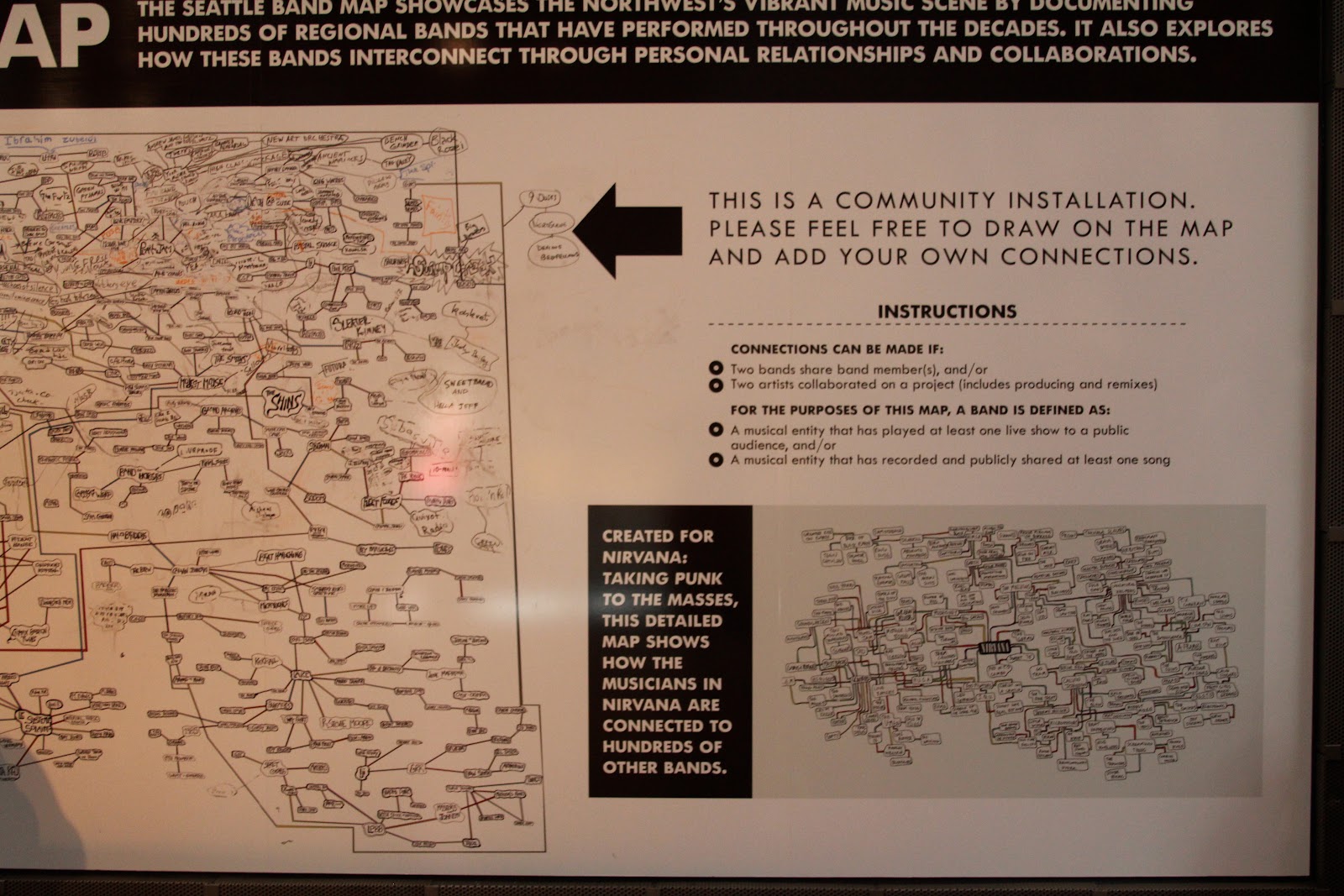
I was surprised to see the number of small and big bands that have come out of the Pacific Northwest, especially the Seattle area.  Here is a picture of the map of the region with the names of the bands that originated here and the interconnections amongst them that was displayed in the museum:


                              Nirvana and other bands in the map displayed in the Experience Music Project

The museum also had a demo room where one could try out different musical instruments, in fact, there is a table where you can tap on the images of drum-like instruments from different cultures and hear what they sound like. There are karaoke rooms where one can sing along like a professional recording an album for a certain allotted time. If I remember the names of the songs and the artists correctly, I tried some songs such as Sarah McLaughlin's 'I will remember you', Nirvana's 'Smells like Teen Spirit' and a couple others by Stevie Wonder and Heart ('Crazy on you'). I had never heard any of them before as far as I could remember except the song by Sarah McLaughlin.


                    An exhibit featuring different kinds of guitars at Seattle's Experience Music Project

They could build a musical center along similar lines in India, we have a ton of classical instruments that would educate millions about music.
One of my friends and I were discussing this long ago that the music industry in India should start having its own identity. We need to move away from the mundane lyrics on love and hot girls so that the youth can express their aspirations, dreams and frustrations through music, come up with original scores and styles and, in short, create a unique profile.
I am sure there are many Indipop bands now that I do not know of. Pop artists such as Alisha Chinai (who can forget 'Made in India'), Suneeta Rao, Shweta Shetty (loved her 'Deewane deewane to deewane hain') and many others truly did light up my school and college days.

It is true, music can cross all barriers, but only if you open your mind.  Many of us keep listening to the old and familiar in the languages we know rather than new melodies in other languages, even those of our own country. Thank goodness A.R. Rahman was discovered by the Hindi film industry and later by Hollywood or else many would have never been exposed to his brilliant and refreshing musical scores.
I have a theory: it has a lot to do whether you are a 'lyrics' person or a 'tunes' person. I am more of a 'tunes' person, that is, I tend to focus more on the melody than the lyrics, in fact, I completely bungle up words in songs at times so I am game for music in any language.
There is an earlier post of mine on encouraging a wide variety of vocal chords in the Indian music industry.

All said, I am deeply grateful for the freedom and ability to enjoy all kinds of music and cannot imagine life without it.

Note: This post has been slightly modified since yesterday. Please look for text in italics and brown for updates.

Tuesday, September 27, 2011

The last post should have been titled Doctor Zhivago

The last post should have been titled Doctor Zhivago because that is the name of the novel. Sorry about that.

Dr. Zhivago - Some thoughts - On freedom

I started reading Boris Pasternak's Dr. Zhivago a few days ago.
Set in the early 1900s, this novel has the backdrop of a tumultuous period in Russian history - the start of the Bolshevik revolution that transformed the country into the world's largest, (probably the first?) and most dreaded Communist regime. I am reading the version translated by Richard Pevear and Larissa Volokhonsky.
First of all, this is not a novel you can read casually while the radio is belting out your favorite songs and you have other things on your mind. The book has so many details that to truly grasp the era in which it was set, you have to give it all, mind, body and soul.

The novel started me thinking very deeply about individual freedom, political and economic freedom, socialism, communism, democracy, capitalism, the Cold War and America's role in promoting democracy around the world. I did a Wikipedia search on democracy and was astounded at the sheer volume of data on this subject. I knew that the ancient Greeks had pioneered this concept and that there were some ancient/medieval kingdoms in India that had some form of democracy, too.

America did not invent democracy; rather, it was one of the first governments to implement a direct democracy (voting by the people) and do away with the monarchy completely.
This is what other people should realize when they feel that America is imposing their way of life on the world or when they are bristling with a mix of anger and envy at the U.S. branding of democracy.

The concepts of individual freedom, welfare and human rights were espoused by Jesus, too, in a slightly different fashion and perhaps by many ancient faiths such as Buddhism. The Indian emperor, Asoka, who was a violent and over-ambitious warrior, embraced Buddhism and repented for his ways, then transformed into a peacemaker and defender of compassion.

Individual freedom and rights got translated into the political sphere gradually with the introduction of democratic practices. Some city states had councils elected by a portion of the general public and slowly, over the ages, through the landmark document of Magna Carta and violent revolutions such as the French Revolution, every individual has come to matter in decision making. There were local village councils and tribal societies where some form of popular consensus was involved if not direct voting. Even the U.S. gradually granted suffrage to non-white people and women. In short, democracy has been and continues to be a "work in progress" (do see this post on 'work in progress' by one of my favorite bloggers). All the above information is gleaned from Wikipedia although I must credit my old school history books and other sources of information on the Internet, too.

I was thinking - what contributes to some societies descending into totalitarianism and some others making it as free societies with good law and order? Imagine if India were not led by Gandhi and Nehru but by some over-enthusiastic communist revolutionaries ready to take the law into their own hands. Would India have (shudder) descended into a despotic dictatorship or communist regime like China, the former Soviet Union or Vietnam or Pol Pot's Cambodia? For all their shortcomings, India was lucky to have leaders with the humanitarianism and insight of Gandhi, Nehru, Sardar Patel and others.

I felt terribly sad for Russia, for all those lost souls who were too afraid to speak up against a cruel regime, for those who lost their lives and families in opposing it, for their lost ideals and potential.
From what I read and have seen in the past, Russia was a land of  poets and intellectuals such as Leo Tolstoy and Fyodor Dostoevsky, of ballet dancers, music composers, great thinkers and romantics, men and women of peace, justice and idealism.

[I am loving Wikipedia! I learnt a lot more about Tolstoy and Dostoevsky (also spelled as Dostoevsky) than before. I did not know that Tolstoy was instrumental to Gandhi's principle of non-violence and other ideas directly although I knew that they were friends.]

Classical proverb: The pen is mightier than the sword.

Coincidentally, I am reading this novel during the Banned Books Week. Doctor Zhivago was banned in the Soviet Union for a really long time and the author, Boris Pasternak, had to even turn down the Nobel Prize in Literature.
I have come to realize that one's understanding of literature, the characters, the milieu and even views on romance, marriage, family life and world views as espoused in a novel, can only be truly fully grasped when you know the socio-economic and political background of the author. This is even more so in the case of certain novels, such as Doctor Zhivago.
I had read somewhere (can't find this resource now) that a work of art is so unique that the loss of an author/artist is irreplaceable. In science, however, the discovery of a principle or law of the universe or anything that exists can be done by subsequent generations, even if the scientist were not there. As a student of science, I remember feeling a little riled up about this piece but I know know that this does not mean that the contributions of Newton or Einstein or Pasteur are to be devalued. It is just that art is ultimately the world view and even the soul of the artist whereas science's discoveries belong to the universe itself.
They should teach courses in school that are holistic, that involve history, contemporary literature and art, science and economics, religion, all rolled together into a delicious intellectual stew so that students appreciate how different ingredients blend together. More on that later...


Tuesday, September 20, 2011

Neuro-Linguistic Programming series

There is a new self-improvement technique that I am currently exploring - Neuro-Linguistic Programming.

I have been listening to some sessions for free online, having come across this courtesy of Steve Pavlina.

This is a series put together by Learning Strategies. There are two presentations and a bonus presentation that is being offered free of charge until Thursday. The series began on September 12, 2011. I did not start listening until day 4 (to the previous day's presentations) and have been forwarding it to all my friends.


Here's the link:


http://www.learningstrategies.com/NLPMindfest

You can listen to new daily sessions from 9 p.m. Eastern Time until the same time next day, for ten days starting from September 12, 2011. 

After the 10 day period, one has to pay for it.


NLP stands for Neuro-Linguistic Programming and is designed to help you understand yourself better,  get rid of negative thoughts and behaviors and live up to your true potential.

www.learningstrategies.com
An online Festival of Powerful Change and Achievement brought to you Free of Charge by Learning Strategies!


Wednesday, September 14, 2011

It is ordinary citizens that make a city

People generally think of icons such as Mahatma Gandhi and Nelson Mandela or Mother Teresa when they talk about the people who have made the most difference to a country or to humanity at large.

However, the common citizen has a lot to contribute, too, and thousands of responsible, fun-loving citizens doing their everyday jobs with passion truly make a city a great place to live or visit.

While I was in India, I probably did not appreciate the fruit vendors, the 'chaat' (spicy Indian fast food commonly sold on streets) stall owners and the artists who would draw giant 'rangoli' portraits of Jesus or Hindu deities as much as I notice and admire the stall owners who sell hand crafted soaps or fresh blueberries or paintings drawn by hand. The United States as commonly seen on TV and in Hollywood movies is depicted as a country of fast-paced, modern cities with skyscrapers, glamorously dressed folks, cool stores and restaurants.
There is another fascinating side to the States - that of the country life. People who own small farms and even vineyards, starting up their own winery or bakery, in short, agro-entrepreneurs - pardon me, this is a term that I have coined myself:). There are city fairs where you find vendors selling charming products such as all natural handmade soaps, lotions and candles, folks who sell handicrafts, paintings and bracelet charms.


Above:  The marketplace under the banyans in Lahaina, Maui, Hawaii where artists sell their wares                                      
Below: Tender coconut shells near a small roadside stall in Maui, Hawaii

There are those people who run their own outdoors company and take customers out on fun rafting/snorkeling/scuba diving trips. These are filled with young, enthusiastic people, typically those out of college or older employees who take up summer gigs.


                                          Sand dune buggy ride in Florence, Oregon  

Then there are the myriad restaurants, serving up everything from freshly squeezed juice to pastries to steak or purely vegan/vegetarian restaurants. In fact, the number of small coffee shops, bistros, patio restaurants and bars in many US cities is simply staggering. This is not even counting all the 'proper' restaurants serving three course meals.

                                                 
                                          City view of Seattle from Queen Anne Hill

Case in point: A few weekends ago, we were on a visit to Seattle. While meandering around the picturesque and warm, welcoming Queen Anne neighborhood, we walked into this absolutely charming coffee shop tucked away in a corner. To top it off, it was next door to a bookstore, Queen Anne bookstore. The cafe is called El Diablo and they serve Cuban style coffee such as Cordanito and snacks such as chips with mango salsa. The interior decor is absolutely funky, combining Spanish style colors with the eccentricity of the Northwest. They have a sofa in a corner called the Love Grotto:) and another wall shows a picture of a devil like creature whispering 'Drink more coffee' and an angel whispering 'Eat more cake' to the same guy.
I fell in love with their Cafe Con Leche which is a latte concocted with Cuban style espresso with the sugar mixed in and foamy milk. Mmm... The accompanying mango salsa with chips and the toast that I had ordered were absolutely lip-smacking. The prices were reasonable, with some items being slightly above that in, say a Starbucks although I must say their menu is unique and has options for vegetarians and vegans, too.


                                          Flower bouquets at Seattle's Pike Place Market
                                                
No matter what you do for a living, if you do it with all your heart and contribute to the community around you while acting as a conscientious, good citizen, you are enriching your neighborhood, city, country and the entire world. So blaze a trail in your own way. Build eco-friendly, charming structures, grow and sell organic produce, decorate interiors with ethnic charm, offer free dental/medical services occasionally to the poor, volunteer at the local park, do something that makes a positive difference.

It is the citizens that make or break a city.


Tuesday, September 13, 2011

The abortion issue - Part I

I was watching the Republican Presidential nomination debate last night. One of the candidates mentioned President Obama's policy regarding the Plan B contraceptive and opposed it, classifying it as 'the abortion pill'.
The Plan B contraceptive as most of you would know is also known as 'the morning after pill'. When you have had a wild drunken night and have forgotten to use protection and are freaking out about getting knocked up, that's the pill that would probably first come to the top of your mind.
The main reason for objecting to this emergency contraceptive is that it may facilitate abortion by preventing the already fertilized egg from implanting in the uterus, thus killing off a potential living being.
However, the site for the Plan B contraceptive categorically states that it does not affect an already existing pregnancy.
Some people such as the group Physicians for Life disagree.
I am not a gynecologist so I would advise people reading this to search for information on contraception from reputed health sites or ask their doctors. Anyway, I am trying to explore this issue from different angles and the perspective of public policy making.

I was thinking: True, even if this pill may not allow the fertilized egg to grow into a fetus, isn't that a better alternative to allowing abortion at a later date? There are two possibilities if the abortion pill were not freely available but regular abortion were to be legal in at least some states:

Depending on religious beliefs, economic conditions and proximity to the place where abortion is legal, a woman could either
(a) choose to abort an already implanted embryo    or
(b) carry the pregnancy to full term and then decide whether to raise the child or give him/her up for adoption

Note: The following argument is based on the premise that Plan B actually worked to prevent the fertilized egg from implanting rather than preventing fertilization. 

***************************Begin ************************************************

If you are a staunch believer that the fertilized egg should have the same status as a fetus with a head or even a real baby, then this issue is a closed book. There is no Plan A, B or C that is relevant.

However, if your beliefs are such that an egg < embryo < fetus < baby meaning that at each stage from conception to delivery, the status of the incubated life increases or any variation of this theory, then it is highly probable that you would abort an actual embryo or fetus that has started to develop tiny body parts if you did not have access to Plan B.
There could probably be guilt involved even if you called yourself pro-choice. Even the ardently pro-choice left wing radical would definitely say that Plan B is more humane even if you assume the worst about it.

Even if I were a staunch believer of the former, strictly conservative kind, I would probably be served better by preventing an actual abortion procedure involving killing an embryo or fetus even though it is not completely congruent with my beliefs. The Plan B option is a kind of compromise but a politician can only do so much. One cannot force one's beliefs down another person's throat.

*************************** End ************************************************

First of all,  the chance that this pill would actually work in the manner that is against religious conservative thinking is actually very small. A woman would have to have to be in her fertile period with a mature egg released for this to occur. This period lasts for hardly one or two days in the entire menstrual cycle.

The trouble I see with Republican candidates is that many of them want to stick to their beliefs without considering pragmatic solutions that benefit everyone, regardless of religious beliefs.
They forget that once they get elected, they will have to work with all sorts of people, even those who do not absolutely share their convictions.

Tuesday, August 16, 2011

What is your Eccentricity Quotient?

Everyone has heard of an Intelligence Quotient (IQ) and Emotional Quotient (EQ). In a nutshell, these are the scores that generally tell you how smart you are and how well you will perform in a social setting, respectively.

I think there should be a third one, an Eccentricity Quotient for people who can think outside the box and come up with creative, even out-of-the-world solutions and products.
You may have a high enough IQ to crack any math quiz or crossword puzzle and have the charm, grace and people skills needed to be the President of the United States or the CEO of a Fortune 500 company but may not be able to push beyond the boundaries of established thinking.
A person such as Albert Einstein or Steve Jobs truly thinks outside the box no matter what their field. Many geniuses were eccentrics in their own right.

There is a book titled, A Whole New Mind - Why right-brainers will rule the world by Daniel H. Pink.

This post has ideas that are somewhat related to the premise of the book mentioned above.
Disclaimer: I have only skimmed through the book, not read it completely.

I am not sure if all the people I talk about in this post would qualify as right-brainers but they definitely have one thing in common: they are a cut apart from the pack.

Eccentricity Quotient may not even be just a brain function, it could be a combination of creative brain power, talent and pure, raw guts.


Think of a rock band such as Nirvana, film makers such as Martin Scorsese or Alfred Hitchcock, the iPod/iEverything conceiver Steve Jobs, the legendary artist/sculptor/mathematician/scientist Leonardo Da Vinci or even the Wright brothers (who would have thought that someone would actually successfully build a flying machine?). There may be several more in the field of medicine or science taking paths that the ordinary mortal fears to tread.

An eccentric does not have to dress or walk or talk like someone completely out of place with his/her surroundings. They may fit perfectly well otherwise in their social settings. They may not even build/create products. It is their willingness to think beyond generally accepted hypotheses that sets them apart.

For that matter, I would count Malcolm Gladwell (author of Blink, Tipping Point and Outliers) and the authors of Freakonomics (doesn't the name say it all?) Steven Levitt and Stephen Dubner, too, in this category. Until I read Freakonomics, I did not ever think economics could be so much fun and encompass so many different realms of life. Of course, economics is involved wherever any transaction is present, be it prostitution or investment banking but the way the subjects are dealt with is what sets this book apart.

Outliers confirmed my suspicions about the over simplification of success stories and opened new portals of understanding. This is out-of-the-box journalism.

Nikola Tesla, the discoverer of alternating current (AC), the bedrock of industries and modern cities, was an eccentric, too. He challenged none other than Thomas Edison, the inventor of the electric bulb with his theory that locked horns with Edison's theory of Direct Current (DC) being the solution to all electrical problems. One of the channels, Discovery or Science, had a nice program on the rivalry between Tesla and Edison when Tesla was employed by George Westinghouse.
Do check out the Wikipedia page of Nikola Tesla. Most people would have heard of both the great men, Edison and Tesla and their contributions to the field of electricity and to the progress of humanity. I did not know this much about the man, Tesla and the staggering number of devices and theories that he came up with.
At the time I started this column, I was writing in general about people who strayed off the beaten path but the Wikipedia article blew my mind. He was a genius!

And let us not even begin on Charles Darwin. Can someone imagine telling people who only believed in the literal world of the Bible that humankind descended from apes? That must have taken a lot of nerve.

Think of Gandhi. When the world was going to war left, right and center, Gandhi successfully pioneered what was probably the very first non-violent political uprising on a mass scale in recent history. I may be wrong on the word 'first' but I've never heard of anything of the sort anywhere else prior to the last century.

People who think out of the box today are far less vulnerable to persecution, especially in developed democracies such as the United States. Remember Galileo was not so lucky in his day.

However, without them, the world as we know today would probably not exist. We still have a long way to go in every field, be it energy efficiency, personal relationships, crime prevention or world peace.

May the eccentrics not hide their gifts.

Note: All links, with some exceptions, point to Wikipedia and Amazon.com


Sunday, July 17, 2011

Article in Brink about The Museum of Broken Hearts!

I just discovered 'Brink', UC Berkeley's magazine today.

There is an interesting article featured in the magazine about the museum of broken hearts in Zagreb, Croatia.

I liked the author's views on experiencing love and heartbreak rather than numbing it with medical painkillers. Like Jim Carrey's character in 'Eternal Sunshine of the Spotless Mind', we try to hold on to our loved one's memories desperately. Sometimes, time and new experiences, fresh new faces in our lives help to see things from a different perspective and the pining gives way to a more detached memory of the beloved. There may be some extreme cases when the hole in one's heart does not get filled completely.

However, trying to circumvent life by medical means is missing out on the chance to experience life firsthand and grow as a person. Someone once asked me,"How do you know it is love?". I do not know the precise answer but I do have a strong feeling that true love elevates you spiritually. It forces you to look within yourself, sometimes getting you closer to God or the unknown forces in the universe. It makes you take a good hard look at yourself and find ways to improve yourself and move on even after the relationship is over. Some people take up learning a new language or career advancement, some people become more empathetic and a sounding board for people in similar situations. True love does change you forever.
It can happen before marriage, outside of marriage and any other socially sanctioned setting but it does exist.

It is important not to let the experience embitter you like some people who become cynical about love itself and start bashing men, women and all relationships in general.

I agree with the author's take on getting over heartbreak. There are people who have killed themselves over a broken heart like Devdas and, maybe, for certain extreme cases of suicidal depression, some medical help may be the need of the hour. However, for the rest of us, a good dose of philosophy, spirituality and just plain living and appreciating the small things in everyday ordinary life can get us by.

When you are sad, remembering that life is precious forces you to look at things that you previously took for granted like the love of your family and friends, the beauty of sunshine or blooming flowers, etc.

Life experiences such as love and heartbreak also cause one to question previously held beliefs and open your eyes to a new reality and the vast possibility that Truth has many facets and we as humble human beings may get to see just a few in one lifetime.

I do believe that feeling true love is a gift, even if the other person is not present in your life anymore. We are all together in spirit, as one of my favorite self-help gurus, Steve Pavlina, would say. The hardest part to get over is the regrets that one could have done more to save the relationship. Here, too, spiritual practices such as yoga can help forgive oneself. I found this great yoga article about self compassion.

I hope we as a species do not run away from our unique experiences and become a medicated, dull society with no ups or downs in our minds, just a steady chugging along. Life would truly be robbed of its meaning and potential to think outside our narrow socially conditioned boxes.

Thursday, July 14, 2011

Mumbai terror attacks - an introspection

On July 13, 2011, terrorists hit Mumbai yet again.

As a former Mumbaikar, I, too, am tired of hearing about Mumbai's resilience. For me, it's yet another depressing episode, mixed with worry for my family and friends and relief that they are safe and wondering if I have to someday face what loved ones of those killed are going through now. I can only pray for those affected. Then there is the guilt that I am far away from India and unable to do anything much except write about it, discuss and argue and think about what I can possibly contribute to make the state of affairs better.

There are other related posts written by famous bloggers such as GreatBong.

Yes, we should have had more surveillance cameras installed. Yes, we should have done more in terms of intelligence gathering. The public should put more pressure on our politicians to actually start doing something and demand more accountability. However, it also gets to me when people start drawing comparisons with the United States.
The United States has immigrants from all over the world but generally, the ones who chose to emigrate do so to make a better life for themselves and their families. While the U.S. has historically had issues with race, it has not faced even 10% of India's problems regarding religion. Even today, the U.S. is a largely Christian Protestant and Jewish country (even the atheists and agnostics have been raised in a Judeo-Christian ethos).
There is one more important factor: there is little or negligible home grown terrorism as yet.
America's war on terror has predominantly been waged on foreign shores.

India, on the other hand, is still a developing nation with a historical record of religious strife such as riots between people of various faiths - Hindu, Muslim, Sikh to name the most common, a bloody partition in 1947 whose scars haunt us till date, Islamic extremism and separatism in Kashmir aided and abetted by Pakistan and tons of other issues. Even in the distant past before the British took over, India has been victim to Islamic persecution under Aurangzeb and the loot of our temples such as the glorious and wealthy Somnath temple by Mohammed of Ghazni. (Note: This does not negate any acts of persecution by ancient Hindu kings but some such as the above mentioned cases more recent and had a huge impact on our civilization because of their extent).

On the non-religious side, there is mayhem to be battled from Naxalites, criminals, political goons and massive corruption.

While we all hurl abuses at the incompetence of our politicians and the police and intelligence forces, at our secularists and extremists of all hues, the larger issue still remains untouched. Just what exactly are we doing about preventing terrorism and crime in general? No, intelligence gathering is only one facet of the exercise.

Do we spend enough and wisely enough on guarding ourselves to even 50% of the extent to which the United States does? Of course, all the money in our coffers may not see the light of day going instead to our corrupt leaders' vaults but that's another issue.

More than America, countries such as India and the United Kingdom need to approach the issue from different angles. In the recent blasts in Mumbai, the Indian Mujahideen is one of the suspects. Apart from the risk of homegrown terror, India still faces a potent threat from organizations that originated beyond its borders and then infiltrated India. In the past, Islamic terrorist outfits such as the Lashkar-e-Toiba have been found guilty of involvement in various incidents. Added to that, even if 1% of our misguided youth actually decide to put their violent ideas of religious domination above respect for human life and love of country, we have a huge problem.

We are a nation of a billion-plus people, overcrowded cities with overflowing trains and buses and thoroughfares and the risk that some crude bomb in some crevice or corner will go undetected is very high.

The war on terror is not merely a war of missiles and bombs. It is primarily a war of ideas.
While many terrorist acts are linked to specific ethnic conflicts, when they are powered by a religious ideology, they become monsters that are a danger to human life beyond their region.
How can India combat these forces at a grassroots level? I don't know the answers but we have to nip them in the bud.

Many of society's problems today are not adequately approached from the prevention perspective. Whether is is battling crime or human trafficking or terrorism or even cancer, prevention does not receive as much attention as war or cure. Prevention does not sound cool.

For one, India needs strong law enforcement with greater involvement from the citizens, demanding accountability. There should be more personnel and technology dedicated to anti-terrorism.

On another note, when I read this piece of news, I was shocked. Is public taxpayer money being used to provide special security to Bollywood stars and builders? True, they may be getting threats from the underworld but isn't every citizen at risk from terrorist acts? In fact, the average citizen who commutes by train or bus is probably at greater risk than a film star who has his/her own car and mostly takes a flight for out-of-town shoots. The state should treat all citizens as equal under the law regardless of their status in society. Is a doctor's life less important than Amitabh Bachchan's or Shah Rukh Khan's? High security is provided to the topmost people in public office such the President, Prime Minister and Chief Ministers and extended to a few others who hold high positions in government. In India, however, we have a skewed logic where public money is expended on unnecessary things but not essentials such as better equipment and training for our police forces.
Movie stars can afford to pay for their own security.

As a nation, we need to sit up and do something about our burning issues, not just rant and rail against the system, then go back to our world and throw up our hands in despair.

Thursday, July 07, 2011

Count your compliments

When we have those bad hair days and other awful-appearance days and those times when we feel we are over the hill or too old, it would serve us some good to remember the compliments people sent our way in the past.
Sometimes, I am having a really hectic day at work and a casual chat with a coworker reveals a nugget, "You are so beautiful!" or "You have lovely hair!". (And there are the stares from the handsome coworker, too:)).

It does prove that life is full of pleasant surprises which means that there are still more secret admirers in the woodwork waiting to be revealed :).

I would probably not want the ability to read people's minds. It is sometimes better to assume that people secretly admire you rather than know that they hate you or hold contempt for you.

I am going to keep a note in my diary about all the compliments I have received over the years and have made my day. I also give compliments back to people when I sincerely mean it. People deserve to be told that they are considered beautiful, smart or kind or talented. Pass the love and smiles on!

Monogamy, marriage, family and everything in between

I was reading Mark Oppenheimer's column in the New York Times today which also covers Dan Savage's views and all the comments accompanying it.

I do agree with the overall premise of the article - that absolute monogamy should not be the only standard imposed on all people. Everyone may want different things at different points in their lives but this has to be negotiated with their partner. I liked the overall emphasis on honesty and trust in relationships rather than a universal set of restrictions. After all, marriage as an institution is older than any religion.

What I disagree about is that couples should agree on relationships outside marriage just to keep their union intact for the sake of the children. In an ideal situation, where both partners are happy with each other and are perfectly monogamous, there is no question of really sacrificing that much for the sake of the children. However, if one partner wants out of the marriage due to any reasons and is forced to stay because of the kids, what kind of message does society send out about the institution itself? This is supposedly a win situation for the kids and a lose situation for either or both parents.
Is a perpetually unhappy family member an asset or liability to the family unit?
An institution that is supposed to nurture and protect suddenly becomes a sort of prison for one of the parties. How many people would feel enthusiastic about getting hitched? No wonder there are 'commitmentphobes'.
This is also a patently unfair situation condemning one or two people to many unhappy years. There are studies that even report that couples who worked on their marriage reportedly felt happier 5 years later. However, working it out has different connotations for different people. For example, would you continue to sleep with someone you don't really feel like or are not in love with anymore? Would you constantly battle against the urge to walk out for the prescribed greater good of your family? A lot of relationship advice columns and religious folks would say that this is the responsible thing to do and that to shirk it makes you a very selfish person and that this is the reason for the current breakdown of society.

Disclaimer: I have no experience dealing with such a situation and coming from a country where divorce was and still remains a taboo, I do not have much anecdotal evidence or statistics to support or refute any related arguments. These are, therefore, only my thoughts and the questions that pop up in my head when I read about such topics.

At the heart of this debate is the assumption that divorce means only instability, hostility and the constant absence of one parent from the child's life. What about those responsible parents who handle the divorce with as little hoopla as possible and make an effort to spend as much time with their kids as possible, even together at times? Except in cases of abuse, a divorce is almost always less desirable than parents staying together. However, it does not also have to be the miserable hole that it is sometimes made out to be.

In a society where divorce is the exception, children would probably get affected more as their family is perceived as not normal. However, in societies where divorce is more commonplace and even handled gracefully, it may have a lesser impact.
When it comes to statistics, one has to remember that certain issues such as happiness are not easily quantifiable.

The article also raised more questions about the role of religion in defining relationships and family. I wonder about tribal societies where women actually could have multiple partners and they could have raised their children without the biological father living with the family at all times. By creating laws that are in line with the Judeo-Christian, Anglo-Saxon way of thinking, some social conventions that could have actually been beneficial in many cases, have disappeared.
In ancient societies, fathers often went off to war and were absent or killed, leaving mothers and the entire extended family to raise the children. The nuclear family with just the husband, wife and children was not the universal norm and is still not in several countries.

I do not know about the difference between children raised by separated but otherwise loving and supportive parents and the children raised by parents living together but I do believe that children need love and nurturing to flourish no matter what their living arrangements are.

Friday, May 27, 2011

Balancing nature with city lights

This is about places I love to live in. I must confess I feel suffocated in cities that are just concrete jungles. Strong old trees and grass always make a heart sing.
Some body of water (clean) such as the ocean or at least a great river nearby would be a must on my list of places to live, too.

Not everyone has the luxury of living in a city surrounded by snow-capped mountains or lovely beaches though if you live in the Pacific Northwest in the United States, you can literally have it all - mountains, rivers and beaches (albeit they are cold most of the year), vineyards and even the high desert. I suspect a lot of it is true for California, too, as that state has a wide range of scenery.

However, each place has its distinct charm and advantages and there are always the little places that are still unspoiled. Maybe it is a river near your house surrounded by meadows, maybe it is a small forest that you love to take hikes in, it need not be a famous tourist destination but something that gives you pleasure each time you visit. I would cherish them because in the rapid flow of urbanization, they may be changed forever or even lost. That is where national parks have an advantage - they will be preserved.

When I was a child, I visited villages with my parents and grandmother where soaking in the warm river water was such a pleasure while taking in the view of the countryside with hills and fields across the banks.

I think of Mumbai, India where I grew up. I was very fortunate to have a national park with wild animals naturally living in it close to my house. I simply loved going there for morning walks and runs (note: the wild animals are further inside the park lest you wonder whether I walked among lions:)). During monsoon and early winter, the place burst in greenery and flowers. I did not have great mountains or lots of such forests but even that one park was a great blessing. What's more, this one had tribals living in it and some ancient caves further inside so there was the historical/cultural factor, too. There are lots of cities like this in India that have natural beauty surrounding them but are developing like monsters with concrete skyscrapers, malls and what not eclipsing all the natural surroundings. Later on, the builders add in 'green space' in the form of spacious lawns, tennis courts and sometimes even golf courts. Tavleen Singh of the Indian Express had written an article long back about the lack of urban planning in India.
However, I would like to see those old banyan, ashoka and jamun trees preserved, acknowledged and cherished. The builders have done that in old housing societies but the municipal corporation has done little to maintain tree-lined streets.
When I think of Mumbai now after having visited and lived in at least a few US cities, I am somewhat dejected. While there are flats being constructed with all the modern amenities, there are very few open green spaces or walkable streets left in the suburbs. Mumbai has a lot of advantages just like many of the West Coast cities. It is not as hot as the interior of India during summers or as cold in the winters as it is warmed and cooled by the breeze from the Arabian Sea. It falls under a high rainfall region so there is lush greenery that naturally sprouts here.
Although the city's beaches are now overcrowded and efforts to clean them up probably fall short, residents can drive a couple of hours or take the ferry south to more pristine beaches on the Maharashtra coast such as Alibaug.
The Sahyadri mountains to the east offer opportunities to hike and scenic locales high up in the clouds such as Matheran. Nasik to the Northeast offers vineyards and the countryside full of fresh fruit and vegetables.
If only we recognized all this bounty better and made efforts to encourage tourism, it would help everyone immensely. I would not say that we should always expect the government to do everything in this regard. Maybe if more Indians followed their heart, we would have more vineyards like the one producing Sula Wines and more bed and breakfasts, little dhabas with clean restrooms, etc. Perhaps there could be more hiking groups formed by yuppies seeking an escape from the corporate rat race and the pollution and crowds of the city or maybe there could be an outdoors company that encourages such exploration. I do think there has been an upswing in such resorts/businesses being opened by private entrepreneurs in India.
Having lived abroad for a few years now, I do not know how much India has changed at the micro level. Young India seems vibrant and ready to explore new things in every area of life. They are also seem like a fun, 'can do' lot. There are probably more river-rafting, rock climbing, beach tanning Indians than I know but I certainly feel we still fall short in this regard. Other well known bloggers such as Rashmi Bansal would have a better idea than me.
The point is that the more there are people ready to explore nature, the more the avenues and amenities that will open up. After all, supply does rise to meet demand.

New blog discovered a few months ago

I started reading Steve Pavlina's blog a few months ago and boy, I am glad I did!

He has a fascinating array of articles and the ones that really made me sit up are the ones related to relationships, consciousness and a larger purpose in life.

Warning: You will have to suspend a lot of your preconceived ideas and be willing to challenge yourself. Of course, that does not mean you have to agree with each and everything he has to say just like with any other author.

What Hindus must understand

Note: This was a draft that I wrote in 2006 but never published it for some reason.


A dinner-table discussion that I had about a month ago suddenly veered to religion. It suddenly occurred to me that some Hindus have been having all the wrong expectations of other religions.
Some Hindus complain that while they see the same God everywhere and visit mosques, churches of every denomination and pagodas, gurudwaras, etc., their reverence is not reciprocated. We got to see the facts as they are and not get emotional and expect everyone to fall in line with an all-embracing way of thinking. People of other religions who do not bow down to Hindu deities are not bad people or do not want to take away your right to worship (except the fanatics who resort to crooked means to get their point across).
Not everybody will like you or your religion. If the holy book of some other religion prohibits idol worship, why would they ever want to be a part of your religious ceremonies even if they respect you as a human being and your right to your way of life? If their book claims that theirs is the only route to salvation, why will they ever take you as an equal?
What we need to do is delve deep into our own philosophy and pass it on to the next generation. We do not know our Vedas or Upanashids. How many have even read the Bhagavad Gita? Very few Hindus can even articulate what their faith is all about. If we are not sure about our own beliefs, how can we defend them? Hinduism today, at least the mainstream one, seems to be all about rituals, ceremonies, festivals, going to temples and maybe listening to some holy men.
But somewhere deep within, the eternal truths that have been passed down through the Puranas told to us by our grandparents, maybe even by watching Ramanand Sagar's Ramayana or Sri Krishna or B.R. Chopra's Mahabharata, have been etched into many of us. But, we really need to have a culture of theological research and discussion, like Christianity in the West.
We need not morph into an our-religion-is-always-right mode of thinking. We have made fun of our deities and even incorporated this into our sacred stories. Critical evaluation of heritage is always good for the present. At the same time, we have to learn from others to evolve into a better religion and society.